Monday, January 23, 2012

More than a Bed & Breakfast

Sunday, January 22, 2012

Angela Tidey was looking for a change of occupation and explored various options.  She settled on the hospitality industry and began looking for opportunities somewhere in New Zealand where she could invest the equity she had earned in her home.  Over a two year period several opportunities came along to buy a hotel, a restaurant or something similar.  An old house was for sale in Dunedin (roughly translated, Little Edinburgh) at the opposite end of the country and she decided she would make a move.
The house had been built in 1908.  It was a single story home with an Edwardian (1901-1910) flavor.  When she found it, college students were sharing the many bedrooms but they had taken surprisingly good care of things.  Tin-pressed ceilings, wide wood trim and plaster walls were in good shape.  The old doors could be refinished and the outside siding was still intact.  She took on many of the restoration tasks singlehandedly, hiring an electrician and a plumber to do more specialized work.  Within four months, back in 2007, she had rooms ready to rent as a Bed & Breakfast.  She named her home Bygone Era Bed & Breakfast.  It fit in well in a city that prided itself for it Scottish connections.  
Back in 2007 Angela had a list of 500 things that needed attention, expense and energy.  Five years later, the list is down to to 250 or so.  Carpeting has been cleaned, walls are freshly painted in Edwardian hues, walls and ceilings are insulated for the first time, and plumbing and electricity are updated.  There are now seven bedrooms and five full baths in the house.   Baths are modern, clean and tidy.  A wood burning stove heats the entire house in the winter with supplemental heat from electric space heaters in each room.  All beds have electric blankets.  Art work from local artists hang in every room and in the spacious main hallway.  A living room which all share has a TV, piano and reading materials.  There was tea and coffee available at all hours and even a supply of fresh cookies.
Add to all of this Angela’s congenial personality, eagerness to share her story and her genuine interest in people and you have a wonderful guest experience.  She also has cooking skill and demonstrated it with a sumptuous breakfast.  Sandra chose scrambled eggs which were the fluffiest she had ever experienced.  I had French toast, which Angela served on her “pretty plate.”  Both of us had thick pieces of delicious bacon.  While we waited for the main course, we enjoyed pieces of toast served with homemade jams a friend had recently delivered.  Her eggs come from free range chickens raised by a 12-year old girl who personally delivers fresh eggs as needed.  Tea, coffee and juice accompanied the meal and Angela also sat down for a time to answer our many questions.  
This was our first B & B experience and it was wonderful.  If you are coming to New Zealand, there is much to see and do in Dunedin.  You could occupy several days soaking up the history and culture of the area.  It’s also a vibrant university town with about 25,000 people connected to South Otago University as students, faculty and staff.  But make sure you consider spending at least a night at the Bygone Era Bed & Breakfast.  You will be blessed and impressed.

Dan hard at work in the living room at Bygone Era B & B


Check out the pressed tin ceilings!

Entry hallway


Our bath

Getting ready for breakfast

What a menu of choices!


With hostess Angela

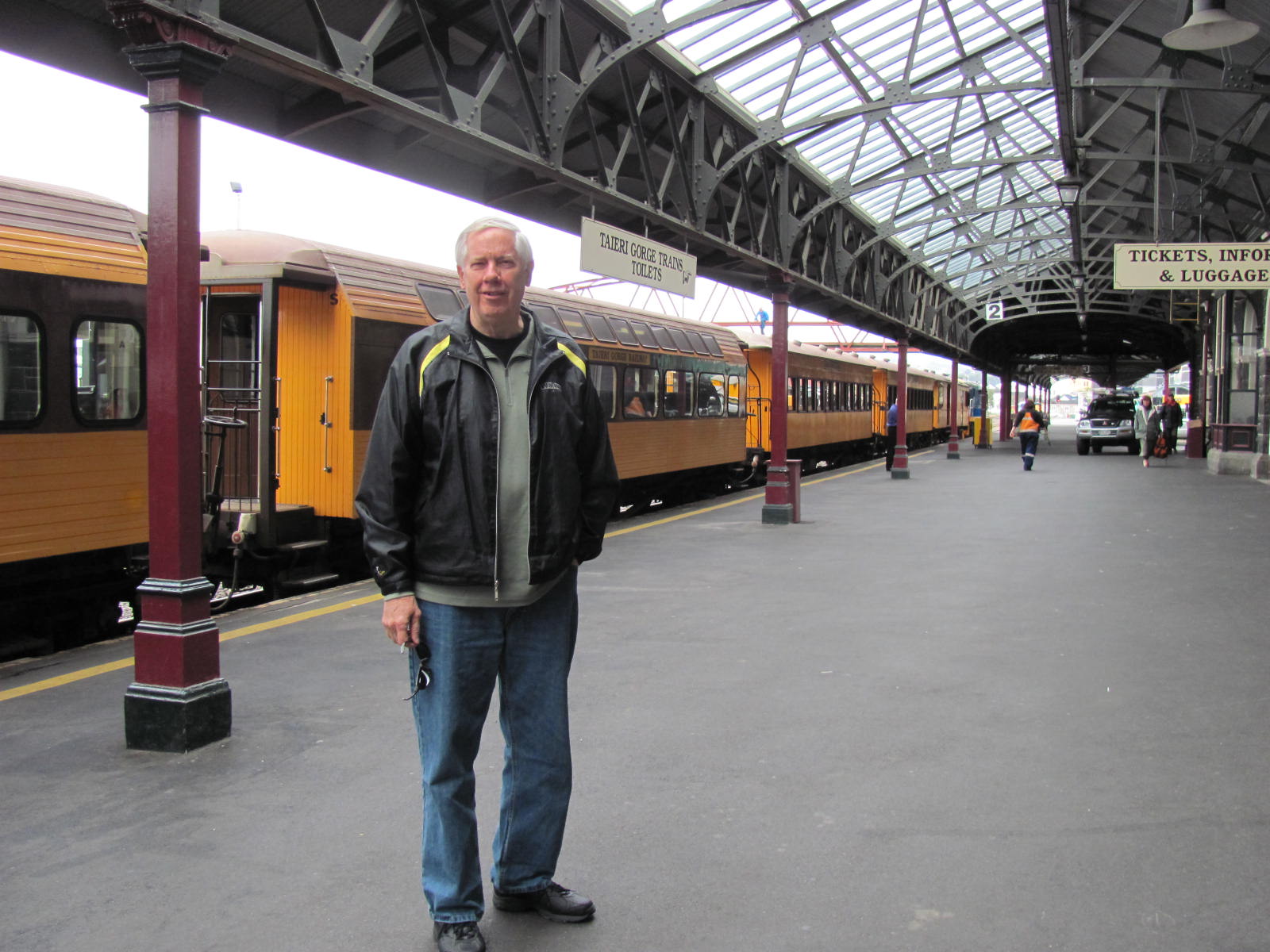
One of the most photographed buildings in NZ - the Dunedin Railway Station

All aboard!


That's Cadbury not Gadbury


Railway Station window


Ornate stairs in Railway Station, Dunedin


Vertical housing, Dunedin, NZ

Sunday, January 22, 2012

Weather or Not

At Christchurch we were eagerly anticipating a trip Up Up and Away in a hot air balloon.  Yes, there was a recent tragedy with a balloon on the North Island, but we were undaunted.  We checked in with the people as we arrived and were advised to call back in the morning at 4:00 am to learn whether things would go as planned.  We would be picked up at 4:30 am in front of our motel and taken to the site.  If all things went as planned our trip would take us up and over the Canterbury Plain at sunrise and we'd be afforded views of the farmland the seacoast, Christchurch and the distant mountains of the Southern Alps.  Sleeping was difficult, waiting for the coming dawn and hoping not to miss the 4:00 wake-up alarm.

At 4:00 the alarms went off and we made the phone call.  "I am sorry to advise you," the recorded message intoned, "but today's flights have been cancelled due to unstable weather on the Canterbury Plains.  Please call our office number if you wish to reschedule."  Disappointment.  Sadness.  But, on the other hand, relief that they don't simply go ahead with things and face consequences later.  So we went back to sleep for a few more hours and contemplated the drive to Dunedin.

The Cookie Time Factory south of Christchurch
Christchurch is the largest city on the North Island and the center of commerce, religion, agriculture and trade.  There is some kind of training center there for people exploring Antartica and it is the jumping off point for trips headed south.  While it has the look and feel of British influence, there are nearby towns such as Akaroa that were settled by the French.  That little village would be worth exploring someday.  It sits in a protected harbor out on the Banks peninsula, which is that little piece of land projecting out to the east of Christchurch as you look at a map of the island.

Our host in Dunedin recommended three stops along the way and we took her advice.  It was raining steadily as we left town and we could see why the flight was cancelled.  Our first stop was unscheduled but unresistable.  The Cookie Time Factory jumped out at us, begging a stop, even though it was Sunday.  That reminds me that we did skip church on this Lord's Day, but we caught a couple of worship services on TV from the motel.  One of them was a commemorative "Praise Be" program recorded in various churches affected by the earthquake.  Very inspirational to see and hear people singing from their churches which are now out of operation.

The Cookie Time Factory store sells broken pieces and irregulars from the factory next door.  Good deals on quantities since the cookies they sell in small "dairy stores" along the way are those big cookies you see packaged one per pack and selling for $1.00 each.  Here they were selling them in a bag for about 50 cents each.  We gave in and bought a their apricot/chocolate chip something-or-others.

Newly restored buildings of Oamaru stone
On to Dunedin.  Place #1 on our stop-and-see list was a town called Oamaru.  It is on the coast and was established back in 1860-1870 as a British port, probably as a place to export sheep and other agricultural goods.  Now they are doing restoration work on old buildings near the harbor.  The buildings are constructed of Oamaru stone, which apparently was quarried in the area.  Check out their website for more details.  We drove through a Sandra jumped out for some photos.

The #2 place on the list was down the road a few kilometers at Moeraki Boulders.  If I were better versed in New Zealand history, I might have a little more appreciation for some big round boulders sitting on the beach.  But there were many people stopping to look, take the trek down to the beach, and then browse through the gift shop back up the trail.  They did have restrooms which are always necessary.

A few more kilometers down highway 1 we came to Shag Point, which juts out into the Pacific and reminded me in many ways of the Oregon Coast.  Seals come to these rocks to rest and sunbathe.  They are joined by shags, a black and white sea bird and albatross.  At another point here, the smallest penguins in the world come home nightly to rest from the rigors of swimming in the ocean.  They are the "yellow-eyed penguins" or hoiho penguins.  We didn't see any from the observation point but we googled a photo to make it look like we did.

From there we made it to Dunedin in time for dinner and a great introduction to our B & B for the night.  More on that later.


What makes these boulders special?


Sleep is good for you!


A yellow-eyed penguin

Saturday, January 21, 2012

Devastation in Christchurch

Saturday, January 21, 2012

We have all probably read about major earthquakes in many parts of the world.  We may have seen the videos or watched movies depicting them.  Some of us may have experienced them first hand.  They strike with little warning, wreak havoc, and the world moves on.  There are after effects, aftershocks and some send tsunamis across miles of water creating more devastation.

Some of that happened here in Christchurch, New Zealand back on February 22, 2011.  There had been warnings and smaller quakes in the year before, but the big 8.3 quake hit on that afternoon and left 182 people dead.  There was destruction and disruption for all who live in this town of several hundred thousand, the largest city on the South Island, and the Garden City of New Zealand.

Today, nearly a year later, the recovery continues.  The receptionist at our motel told us about the "demolition zone" we would find downtown and the chain link fence that keeps people out of the central business district, which was the center of the quake.  We drove to the area out of curiosity and came away touched with the power of natural forces created by an Almighty Creator.  Many of the buildings have been torn down and many more will be removed in the months to come.  It looks like it will be a long time before normalcy is restored.  It is hard to imagine how many people, businesses and other organizations have been relocated, disrupted or simply eliminated.

The photos we took don't tell the whole story, but they give an idea of what happens to people in these kind of events. These are people just like us, whose whole existence has now changed.  Life is a precious thing.  We are blessed to live our lives in pretty normal circumstances.  I thank God for that privilege.  My prayers are with these people whom I don't know, but who face some difficult times in a most beautiful corner of the world.

The central business district is about 100 blocks square

Some buildings were not built to withstand quakes


There was a hotel in this location.


The skeleton seems secure but there's lots of damage.

No more Hotel Latimer


These guys are survivors!


Notice the split in the building!


This looks like a new tower for a church building.


Friday, January 20, 2012

On the Road for a Week

Friday, January 20, 2012

Our time in Wanaka came to an end this morning and we loaded up our rental car and headed out of town, bound for the little town of Twizel, which is near Aoraki/Mt. Cook in the middle of the South Island.  The drive was very scenic, with terrain that reminded us of Eastern Oregon, Wyoming and Montana.  It was a winding two-lane road with moderate traffic going in both directions.  We took our time, which meant we kept it under 80 km/hour, and just about everyone passed us going much faster.

Along the way we saw the herds of sheep that we've come to associate with New Zealand (there are 8 sheep for every human), herds of cattle, wildflowers and farmland.  For the first time we saw the big motorized sprinkling rigs that are pretty common in Colorado and Nebraska.  Irrigation water comes from the many lakes and rivers that are fed by glaciers.  Those same rivers provide hydroelectric power to the country.

As we got closer to Twizel, we saw glacier-fed lakes with water that was a green-blue or aqua color.  At one of them there was a sign for "fresh salmon."  We pulled in to the parking lot and walked out to the holding ponds where they were raising salmon.  Sandra couldn't resist and bought 1 filet, 4 pieces, amounting to half the fish for $14.00.  We brought it back to our "chalet" and she fried it with some vegetables for dinner.

Keep in mind this is the woman who spent most of her life in Alaska and was accustomed to the finest salmon possible, usually caught in the wild, cold rivers that provided spawning grounds for the fish.  So these didn't measure up.  The water was warm, the meat was very soft and the flavor was not even close.  But it was a salmon and we ate and pretended.

We checked in at the Mountain Chalets Motel and then got back in the car for a trip up to Mt. Cook which also goes by its Maori name Aoraki.  It's the highest point in New Zealand.  At its base is the Sir Edmund Hilary Visitor Center.  This is where he did some of his training before he set out for Antarctica and following his successful climb up Mt. Everest.  Pretty impressive.  Lots of photos and displays and of course lots of stuff for sale in the gift shop.  How about a Merino sweater or shirt for only $284?  We almost bought a postcard, but resisted.


Ubiquitous sheep

Lake Pukaki


At Mountain Chalets, Twizel
Mt. Cook/Aoraki, New Zealand's highest point
Enjoy the photos!

Wednesday, January 18, 2012

Eco-friendly Zip through the Forest

Wednesday, January 18, 2012

Zipping through the woods, across a river or down a mountain has been on my mind for some years.  My father-in-law, Fredric Rhode, and I used to talk about the possibility of a zip line (we didn't call it that then) running down from a hill and across the stream at his cabin near Boulder, Colorado.  He had the cable from an old mining operation.  All we needed was some way of attaching it.  

Then after being in Alaska for a couple of summers, I thought about the same possibility at our cabin on the Goodpaster River.  A zip line running across the river - wouldn't that be cool? 

Then there's our house in Oregon.  We're up on a hill - a zip line would be a fun way to go down the hill and into the woods.  The only challenge would be braking to a stop at the bottom and then having to hike back up the hill through the poison oak.

So when it came to choosing an activity yesterday, the Ecotour Ziptrek sounded like fun.  The tour was eco-friendly and the young guides gave us some background on Queenstown and a message for sustainability, along with a very safe trip through four short trips between tree houses.  We also learned how to zip along with no hands or even upside down.  The four zips were rather short.  By the time we got through we had also lost some elevation going down the mountain and we had to make up for it with a long climb back up to retrieve our stuff.  Good exercise, I guess.  

The other rather comical event came as I tried to videotape the trip through the woods.  The first two times I turned on the video camera, which was attached to my harness, but it was pointed down instead of up.  I got good audio but no video, unless you count the blackness of my shirt.  I corrected my error the third time, but somehow it didn't record.  So the 4th time, everything was set and ready.  However, I wanted to try riding upside down and consequently, the camera flipped over and recorded where I had been, upside down.  It's pretty comical, all right.

It was interesting to note that the forest was Douglas fir trees imported from the Pacific Northwest.  The mountain was once bare and they wanted something fast growing to prevent flooding.  The firs did the job, however, now they would like to replace them with beech, which is more native to New Zealand.  The firs are tall, messy and grow like crazy.  We've heard more than one story like that since we arrived.  Look up moa in Wikipedia and see what you learn about sustainability.

Notice how you step off into space


The leaders with yellow hats

Sandra zipping off into the woods

Enjoy the photos!